Introduction
For many candidates preparing for the Resus Council UK Advanced Life Support course, the cardiac arrest algorithm feels deceptively simple. It is memorised early, repeated often, and appears straightforward when written on paper. Yet in the exam environment, where time pressure, noise, and expectation converge, that same algorithm becomes significantly harder to execute.
The difficulty does not lie in recalling the steps. It lies in applying them in a way that is structured, timely, and clinically sound while simultaneously leading a team. This is where candidates either demonstrate real competence or begin to unravel.
Understanding how to use the ALS cardiac arrest algorithm rather than simply reciting it is what separates those who pass comfortably from those who struggle.
The Reality of ALS Assessment
The ALS assessment is not designed to test whether you can list the sequence of interventions. It is designed to determine whether you can manage a cardiac arrest in real time. This includes recognising the situation immediately, initiating appropriate treatment without hesitation, and maintaining control of the team throughout.
Examiners are not looking for perfection. They are looking for safe, structured, and decisive practice. Small delays, uncertainty around rhythm interpretation, or poorly timed interventions often carry more weight than minor factual inaccuracies.
Candidates who perform well tend to appear calm and methodical. This is rarely because they feel relaxed, but because they have internalised a framework that allows them to function under pressure.
The First Moments of Cardiac Arrest
The opening phase of a cardiac arrest scenario is often where the trajectory is set. A candidate who hesitates early may spend the rest of the scenario trying to recover. In contrast, a candidate who establishes control immediately tends to maintain it.
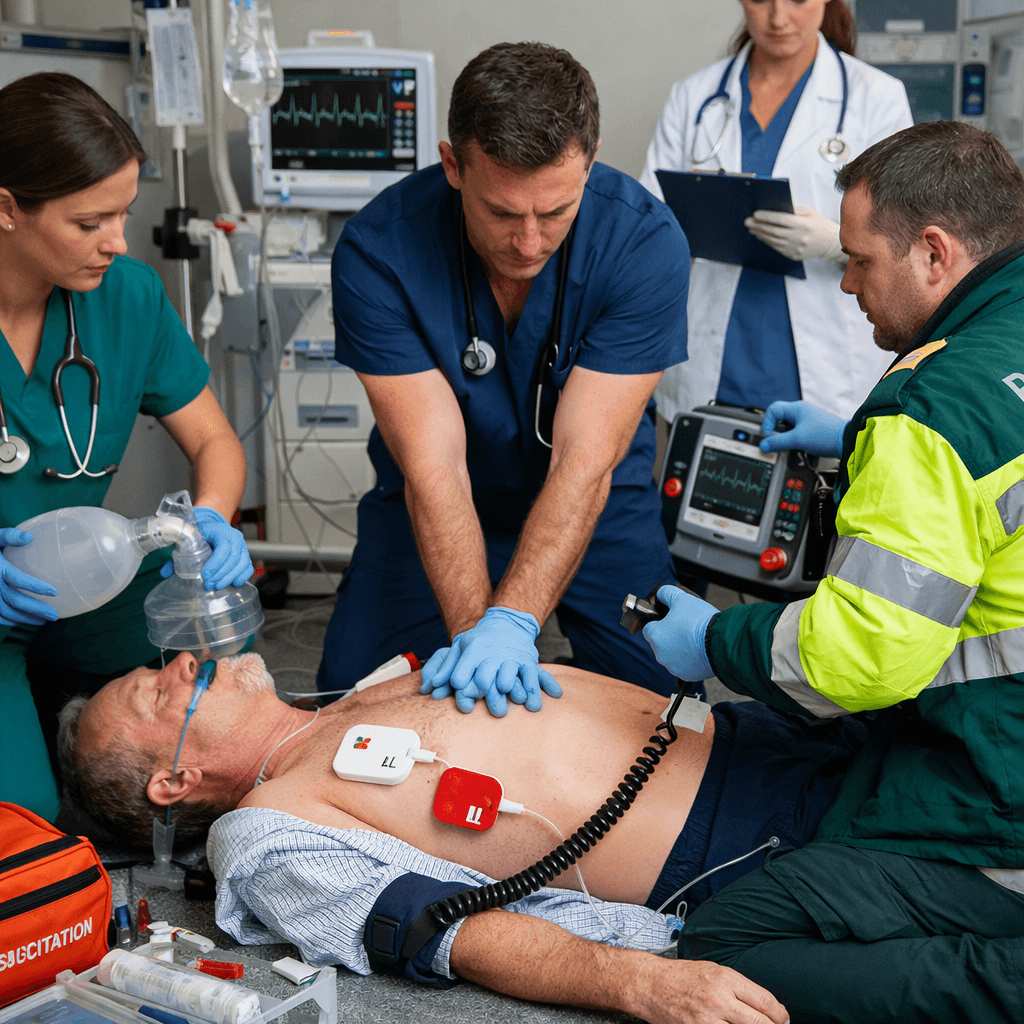
Recognition of cardiac arrest must be rapid and confident. An unresponsive patient who is not breathing normally should trigger immediate action. Chest compressions should begin without delay, and help should be clearly called for. The defibrillator must be brought into the process as early as possible.
Equally important is the assumption of leadership. This does not require authority in tone, but it does require clarity. A simple, direct declaration that the situation is a cardiac arrest, followed by clear instructions to the team, demonstrates control from the outset.
The Central Role of CPR
High-quality cardiopulmonary resuscitation remains the foundation of ALS. While this is universally acknowledged, its execution under exam conditions is often inconsistent.
The key issue is not whether compressions are started, but whether they are protected. Interruptions in CPR are one of the most common and avoidable problems seen in ALS assessments. These interruptions often occur during rhythm checks, defibrillation preparation, or moments of uncertainty.
Strong candidates build the entire resuscitation around continuous compressions. They anticipate when pauses will occur and ensure they are as brief as possible. They coordinate the team so that tasks such as charging the defibrillator or preparing drugs happen while compressions continue.
This level of coordination reflects an understanding that CPR is not one component of the algorithm; it is the constant around which everything else revolves.
Making Rhythm Decisions Without Delay
At the heart of the ALS algorithm lies a single, critical decision: whether the rhythm is shockable or non-shockable. This decision must be made quickly and acted upon immediately.
Candidates often fall into the trap of over-analysing the ECG. In the exam setting, this can lead to hesitation, which is far more detrimental than a slightly imperfect interpretation. The priority is not diagnostic precision but timely action.
If the rhythm appears consistent with ventricular fibrillation or pulseless ventricular tachycardia, defibrillation should follow without delay. If there is organised electrical activity without a pulse, or a flat trace consistent with asystole, the focus must remain on CPR and pharmacological support.
Confidence in this decision-making process is essential. It signals to the examiner that the candidate can function effectively in a real cardiac arrest.
Defibrillation as a Time-Critical Intervention
In shockable rhythms, the speed of defibrillation directly influences outcomes. This principle is central to ALS and is closely observed during assessment.
Candidates who perform well prepare the defibrillator while compressions are ongoing. They ensure that when a rhythm check confirms a shockable rhythm, the shock can be delivered with minimal delay. Immediately after the shock, compressions are resumed without hesitation.
Delays often arise when candidates pause CPR to prepare equipment or become overly cautious in their approach. While safety remains important, excessive delay undermines the effectiveness of resuscitation and is viewed unfavourably in the exam context.
The Subtle Complexity of Drug Timing
Drug administration in ALS appears straightforward but is a frequent source of error. The timing of adrenaline, in particular, must be clearly understood.
In non-shockable rhythms, adrenaline should be given as soon as possible. In shockable rhythms, it is delayed until after the third shock. This distinction is simple in theory but commonly misapplied under pressure.
Examiners are attentive to this detail because it reflects a deeper understanding of the algorithm. Correct timing demonstrates that the candidate is not simply following a sequence but is applying it appropriately to the clinical context.
Communication around drug delivery is equally important. Clear instructions to the team, including drug name, dose, and timing, reinforce leadership and reduce the risk of error.
Thinking Beyond the Algorithm
While the ALS algorithm provides structure, it does not replace clinical thinking. The identification and management of reversible causes remain central to successful resuscitation.
In practice, this means continuously considering what may have led to the cardiac arrest. Hypoxia, hypovolaemia, electrolyte disturbances, and thrombotic events are among the possibilities that must be actively explored.
Candidates who excel integrate this thinking into the scenario. They do not simply list potential causes; they link them to the patient’s presentation and suggest appropriate interventions.
This demonstrates a level of clinical reasoning that goes beyond rote learning and aligns closely with real-world practice.
Airway Management in Context
Airway and ventilation are essential components of ALS, but they must be managed in a way that supports rather than disrupts resuscitation.
Basic airway manoeuvres and bag-valve-mask ventilation are often sufficient in the early stages. Advanced airway interventions, such as tracheal intubation, should only be attempted when they can be performed without significant interruption to CPR.
Candidates sometimes become overly focused on airway management, to the detriment of other priorities. Maintaining perspective is key. The primary goal is effective circulation through high-quality compressions, with airway interventions serving to optimise oxygen delivery.
Leadership Under Pressure
Leadership is one of the defining features of the ALS assessment. It is not enough to make correct decisions; those decisions must be communicated clearly and executed through the team.
Effective leadership involves assigning roles, anticipating needs, and maintaining an overview of the situation. It also requires the ability to adapt as the scenario evolves.
Candidates who struggle often do so because they become internally focused, concentrating on recalling the algorithm rather than directing the team. In contrast, successful candidates externalise their thinking, using clear communication to guide actions and maintain structure.
Maintaining Structure Through Cycles
The ALS algorithm is built around repeated cycles of activity, typically lasting two minutes. Each cycle includes CPR, rhythm assessment, and appropriate interventions.
This cyclical structure provides a valuable anchor in what can otherwise feel like a chaotic situation. Candidates who remain aware of these cycles are better able to maintain organisation and avoid losing track of time or sequence.
When uncertainty arises, returning to the cycle helps restore clarity. It reinforces the fundamental pattern of ALS and ensures that key steps are not overlooked.
Recognising Return of Spontaneous Circulation
The return of spontaneous circulation represents a transition point that requires immediate recognition and adjustment of priorities.
Signs such as a sudden rise in end-tidal carbon dioxide, the presence of a palpable pulse, or the appearance of an organised rhythm with output should prompt reassessment. Continuing CPR in the presence of ROSC indicates a lack of situational awareness.
Once circulation has returned, attention shifts to stabilisation, optimisation of oxygenation and ventilation, and identification of the underlying cause.
Common Mistakes That Undermine Performance
Across ALS courses, certain patterns of error emerge repeatedly. Hesitation at the start of the scenario, delays in defibrillation, incorrect timing of adrenaline, and failure to engage with reversible causes are among the most frequent.
Communication issues also play a significant role. Unclear instructions, lack of role allocation, and failure to verbalise decisions can create confusion and reduce overall effectiveness.
These mistakes are rarely due to a lack of knowledge. More often, they reflect difficulty applying that knowledge under pressure.
Preparing Effectively for ALS
Preparation for ALS should focus on application rather than memorisation. Practising scenarios aloud, working through decision-making processes, and simulating time pressure can all improve performance.
Developing the habit of verbalising thoughts is particularly valuable. It not only clarifies thinking but also aligns closely with the expectations of the assessment.
Understanding the rhythm of the algorithm, the timing of interventions, and the importance of leadership will place candidates in a strong position to succeed.
Conclusion
The ALS cardiac arrest algorithm is a powerful tool, but its effectiveness depends entirely on how it is applied. Success in the Resus Council UK ALS course requires more than familiarity with the steps. It requires the ability to act decisively, think clearly, and lead effectively in a high-pressure environment.
By focusing on practical application, maintaining structure, and avoiding common pitfalls, candidates can approach both the exam and real clinical situations with confidence. This is ultimately the goal of ALS training: not just to pass an assessment, but to deliver safe and effective care when it matters most.